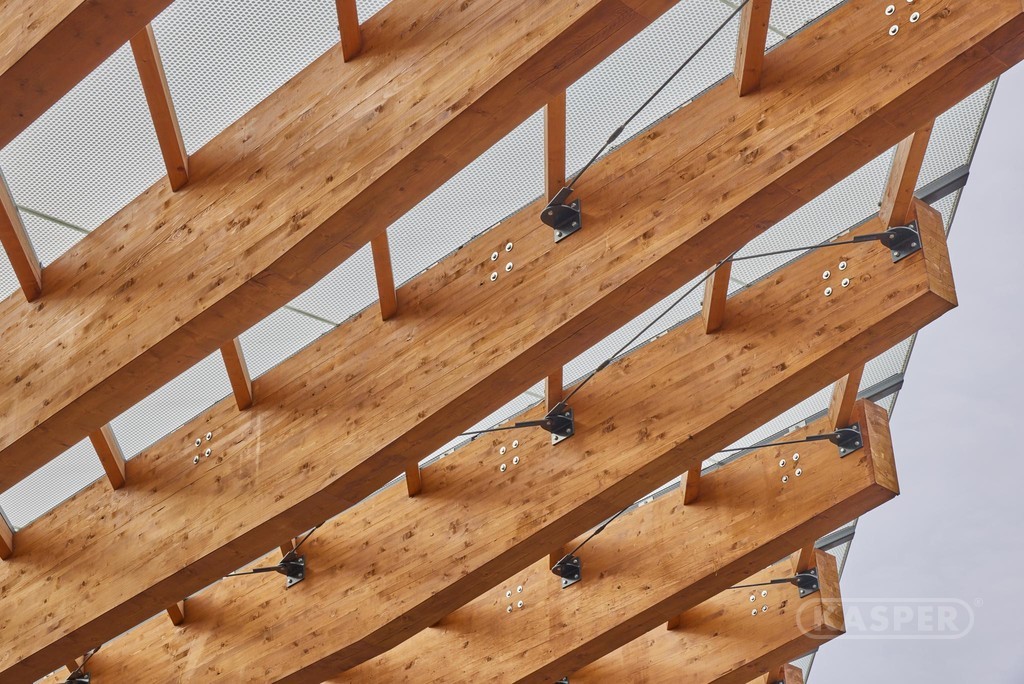
Laminated veneer
wood
The main advantages of glued laminated timber:
high aesthetic value
static reliability, resistance to bending and cracks
extraordinary shape and structural variability
favorable price
quick installation
excellent weight-to-load ratio
dimensional accuracy and stability
high degree of prefabrication
Uses of glued laminated timber:
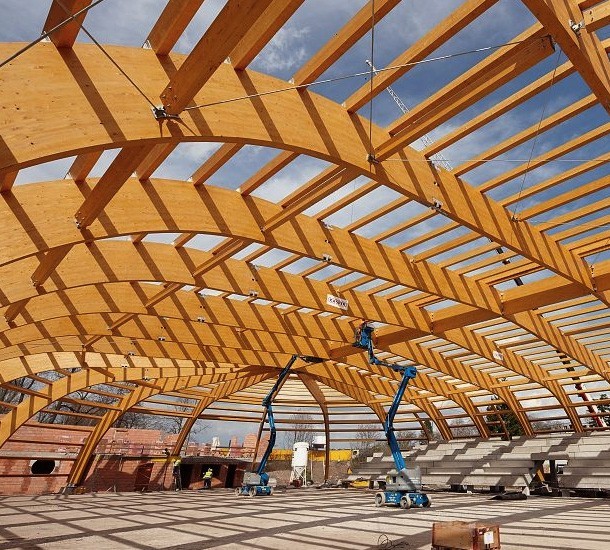
large-span hall structures of various shapes
logistics centers, exhibition and sports halls, riding arenas, swimming stadiums
bridges, footbridges for pedestrians and cyclists
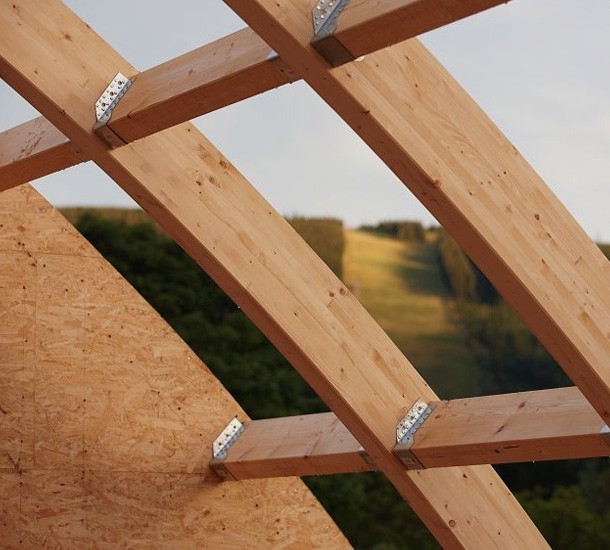
design elements, shelters, atypical structures
Where is it suitable to use glued laminated timber
Glued laminated timber is referred to as BSH. Thanks to its unique manufacturing technology, it is a dimensionally stable material, resistant to warping, while also offering great variability of use. This is why architects favor glued laminated beams - BSH can meet almost any shape requirements and at the same time provide the building with high aesthetic value.
What is specific about glued laminated timber
Glued wooden beams, LLD (glued laminated timber) or BSH (Brettschichtholz) – these are all names for one type of product. It is a material made by the side gluing of two or more laminated pieces of solid wood. The laminates are joined together with a toothed connection. The gluing is done using ecological means based on melamine resin, utilizing a process of transparent glued joints that are resistant to weather influences.
BSH glued beams are planed on all four sides and have chamfered edges. Roof trusses made from glued laminated timber show the structure of the wood, thus giving buildings high aesthetic value.
What properties do glued beams have
Load-bearing structures made from BSH beams always look great. Investors can choose based on the finish the "natural" or "visible" versions. Both are designed for visible structures. The "natural" variant may have slight aesthetic imperfections (firmly embedded knots, repaired spots of fallen-out knots or pitch pockets, holes up to 2 mm), while the "visible" variant has a perfect surface without cracks or discoloration.
Glued laminated beams are produced in several strength classes (GL24h to GL32). The quality of individual parts is confirmed by electronic inspection.
Spruce wood is most commonly used for production, while larch is used for structures exposed to weather effects.
What procedures do we use in the preparation of glued laminated timber for construction
The actual production of glued laminated timber is ensured for KASPER CZ by the Austrian company WIEHAG GmbH, which has more than 150 years of history.
KASPER CZ specialists manufacture the actual structural parts from the supplied material at the wood processing center. To protect them, they subsequently use quality coating systems from Remmers or BASF in stain shades according to the sample book.
In the coordination of KASPER CZ, precise assembly of the roof trusses made from glued laminated timber is carried out on site. This is always preceded by individual collaboration with clients, whether they are architects, investors, or designers.
Technologies used when working with glued laminated beams:
CNC wood processing center Hundegger K2i 1250 (1 pc)
single-blade computer-controlled angle and cross-cut saw (2 pcs)
four-blade angle and cross-cut saw (1 pc)
design software R-STAB, RX-TIMBER from DLUBAL
structural software SEMA
Benefits of load-bearing structures by KASPER CZ made from glued laminated timber
Not only the long history of the company's operation, hundreds of satisfied customers, the use of the highest quality materials, and innovative technologies make KASPER CZ a serious partner for municipalities, investors, and architects. An integral part of our success is a team of professionals who always seek the best solutions for specific constructions.
The main benefit of our structures, in addition to high quality and meticulously executed work, is also a human approach, perfect understanding of the project, and smooth implementation within the agreed timeframe. All this thanks to the effort we dedicate to optimizing corporate processes, continuous employee education, and investments in the most modern technologies.