Wooden
bail
The biggest advantages of trusses with connection plates
up to 40% wood savings and thus also costs compared to traditional constructions
possibility of constructing large spans (up to 35 m)
rapid production
utilization for roofing almost any floor plan
high degree of prefabrication
low weight
quick assembly regardless of the season
we prioritize the use of S4S material – dried, calibrated, and planed timber
Uses of trussed beams with connection plates:
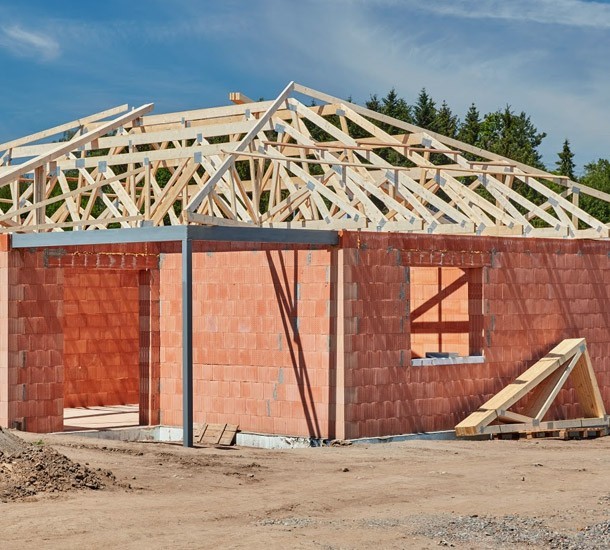
roofs of family houses in various shapes (gabled with used or unused attic space, flat, single-pitched, scissors, polygonal, arch, mansard roof beams, floor beams, gables, half-gables, dormers, risalits, etc.)
large-span roof structures (commercial, industrial, agricultural, and sports facilities)
all-wood systems (bearing “frameworks” of simple industrial and storage halls, bearing wall systems for passive buildings, roof extensions, etc.)
atypical use (formwork for monolithic reinforced concrete bridge structures, obstacles in skate parks, artificial climbing walls, scenery, etc.)
What is a truss
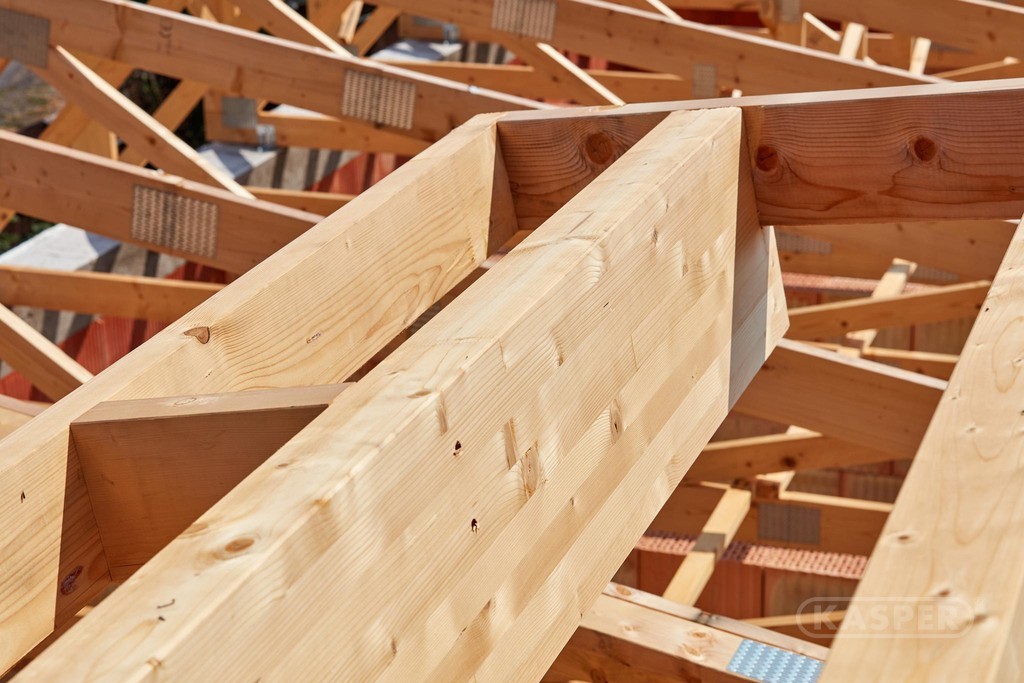
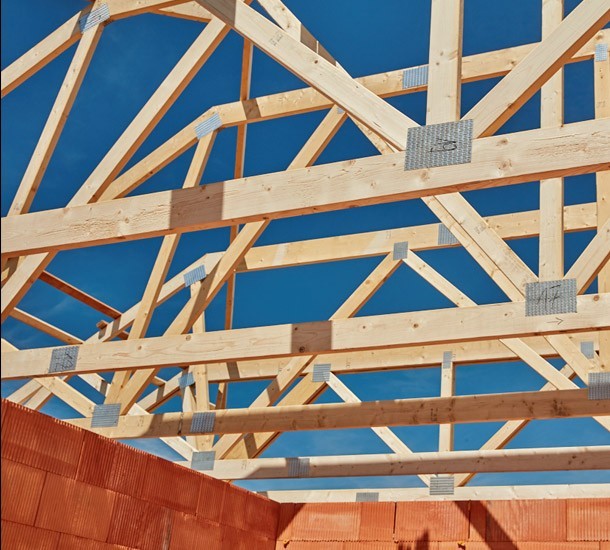
A truss is a plane rod system composed of beam and inter-beam lumber pieces mutually connected by crimping joint plates. Wooden trusses usually have a triangular shape, but almost any roof structure (frames, arches, purlin rafters) can be produced.
Why choose trusses with joint plates
For a truss with a joint plate, it holds that it achieves the lowest slip of all available connection options for lumber pieces and shows minimal deformation. Roof structures using trusses with joint plates excel in high shape variability, one hundred percent strength, easy handling, and thus also rapid assembly directly on site. Joint plates are an extraordinarily simple yet strong and cost-effective variant for connecting individual boards.
Joint plates made of galvanized steel sheet with pressed dowels are installed on both sides of the trusses, ensuring that there is no gap left between them and the wood at all. Trusses are fitted with joints using pressing that is controlled by software.
Technologies used in the production of trusses:
flat press MARK VI (2 pcs)
single-blade, computer-controlled angle and cross-cut saw (2 pcs)
four-blade angle and cross-cut saw (1 pcs)
soaking impregnation tank (1 pcs)
Benefits of wooden trusses by Kasper CZ
You can rely one hundred percent on the quality of materials, adherence to deadlines, and timely construction realization. KASPER CZ has been operating in the Czech construction market since 1994. We utilize state-of-the-art technological support and have a stable and reliable team of employees.
Our primary interest is a satisfied customer. That is why all our steps aim at both simplifying corporate processes, which reflects in the final price of products, and in the continuous education of employees. Investors, architects, carpenters, and designers can be assured that the wooden trusses from KASPER CZ will serve well and for a long time.
How we manufacture truss structures
KASPER CZ utilizes the latest technologies and materials. Even before we commence the production of wooden trusses, we provide every potential client with individual consulting, design the arrangement of the load-bearing structure including a preliminary static design, and prepare a price offer.
We primarily manufacture wooden load-bearing structures with joint plates from four-sided planed dried lumber (commercial designation S4S; without any further chemical treatment), but also from "rough" lumber impregnated against fungi, molds, and wood-destroying insects. To ensure maximum efficiency in the design of the structure, we use timber thicknesses of 45, 50, and 70 mm and heights from 80 to 240 mm. We work with softwood of strength class C24. Chemical treatment of timber (impregnation) is carried out only on "rough" timber in a Lignofix Stabil Extra solution.
We obtain joint plates from BOVA Březnice. Transport is secured based on our manufacturing documentation practically immediately after online ordering. This eliminates the need for large stockpiling while allowing us to have the necessary materials available very quickly.